How to Read a Book's Number Line
The row of numbers on a book's copyright page tells you which printing you are holding. Here is how to read it, including the odd cases that trip people up.
Robin Swain
Author
An open antique book on a desk, turned to its copyright page.
You opened a book to the copyright page and found a row of numbers near the bottom, something like 1 2 3 4 5 6 7 8 9. That row is the number line, and it answers one specific question: which printing of the book are you holding?
It matters because the first printing of a first edition is the version collectors want. Later printings of the same title are usually worth far less. The number line is how you tell them apart, once you know how to read it.
The short answer
To read a number line:
- Find the row of single digits near the bottom of the copyright page.
- Look for the lowest number present. That number is the printing.
- If a 1 is present, it is usually a first printing.
- Ignore the direction of the numbers and any letters mixed in.
So 1 2 3 4 5 6 7 8 9 is a first printing. 3 4 5 6 7 8 9 is a third printing. The rest of this guide covers the cases where it is not that simple.
What the number line actually is
The number line, also called the printer's key, is the printer's record of which run produced the copy in your hands. Each time the publisher goes back to press for another printing, they remove the lowest number from the line. A first printing keeps the full line. A second printing drops the 1, a third drops the 1 and 2, and so on.
So you are not reading the numbers as a sequence. You are looking for the smallest one still there.
Direction does not matter
Publishers print the line in whatever order they like. All of these are first printings:
- 1 2 3 4 5 6 7 8 9
- 9 8 7 6 5 4 3 2 1
- 2 4 6 8 9 7 5 3 1
That last one looks scrambled, but a 1 is present, so it is a first printing. Do not try to read it left to right. Just check whether the 1 is there.
Ignore the letters
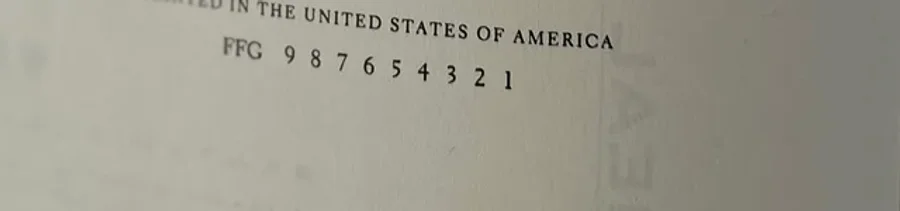
Many lines include letters next to the numbers, like FFG 9 8 7 6 5 4 3 2 1, or a stray A or B. Those are printer and binder codes, sometimes a month or plant marker. They are not part of the printing count. Read the numbers, ignore the letters.
The one exception is a line made entirely of letters. Some older books used a letter key instead of numbers, where A means the first printing, B the second, and so on. Same rule: the lowest letter present is the printing.
A real example
Real lines look busier than the textbook version. Here is the copyright page line from a first printing of Harry Potter and the Prisoner of Azkaban:
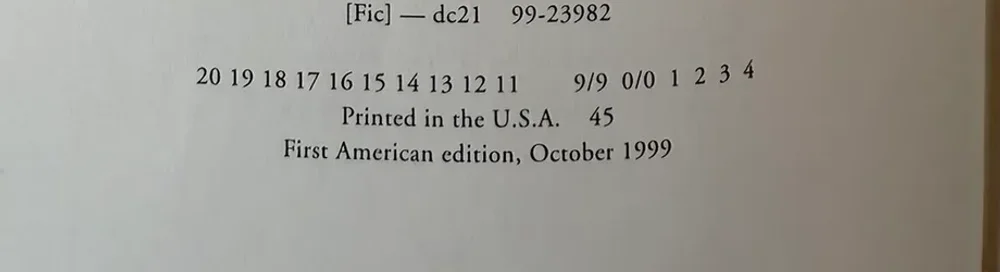
There is a lot going on. The 9/9 and 0/0 are year codes (1999 and 2000), not printing numbers, so ignore them. The 20 through 11 run is part of the same key. The printing numbers are 1 2 3 4, the lowest is a 1, and the page also states "First American edition". So this is a true first printing. Once you know to ignore the codes and look for the lowest number, even a crowded line is readable.
When the words and the line disagree
A book can print the words "First Edition" on the copyright page and still show a number line that starts at 2 or higher. When that happens, the number line wins. The publisher set "First Edition" as fixed type and only updated the number line on later printings. What you have is a later printing of the first edition, which is worth much less than a true first.
This is the single most common mistake people make, so it is worth repeating: the number line settles it, not the words.
Publisher quirks
There is no universal standard, and conventions changed over the decades. A couple worth knowing:
- Random House historically marked a first printing with the words "First Edition" plus a number line ending in 2 rather than 1. Later printings kept the 2 but dropped the words, so the words are what settle a Random House first.
- Some publishers, especially older or British ones, used no number line at all and stated the print history in words or a string of years instead.
If the line is ambiguous or missing, the publisher and year give you enough to look up the specific identification points for that title.
When there is no number line
Plenty of legitimate first editions have no number line, especially older books and some small presses. A missing line is not a red flag by itself. It just means you identify the printing some other way: a stated edition, the publisher's known first-edition points, or the dust jacket details. Book club editions also frequently lack a number line, along with a blind stamp on the back board and no price on the jacket.
The faster way to check
Reading number lines is a skill, and the exceptions add up. If you have a stack of books or an unfamiliar title, you can skip the manual work.
FirstFolio is an AI tool that identifies and values old books from photos. You upload pictures of the cover, title page, and copyright page, and it reads the number line, confirms the printing, grades the condition, and returns an estimated market value range in about 60 seconds.
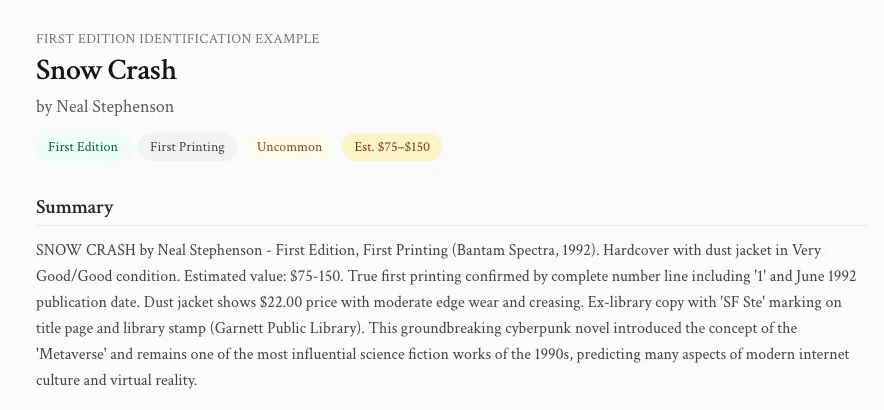
You can check two books free, no card required. Identify your book in 60 seconds.
Frequently asked questions
What does the number line on a book mean? It records which printing you are holding. The lowest number still present is the printing, so a line that includes a 1 is usually a first printing.
Where is the number line in a book? Near the bottom of the copyright page, which is on the reverse of the title page. It is a row of single digits such as 1 2 3 4 5 6 7 8 9.
Does the direction of the numbers matter? No. Ascending, descending, or interleaved, it makes no difference. Look only for whether a 1 (or the lowest number) is present.
My book says "First Edition" but the line starts at 2. Which is right? The number line. A line starting at 2 or higher means a later printing, even when the words "First Edition" appear. The publisher left the words as fixed type.
What do the letters in the number line mean? They are printer or binder codes, not part of the printing count. Ignore them, unless the line is made entirely of letters, in which case the lowest letter present is the printing.
Related reading: