5 American Independence Books That Sold for Real Money at Auction
From a $4.42 million Declaration facsimile to a $203,200 Federalist, five real auction results from the past few years, and what they teach about which copies carry the value.
Robin Swain
Author
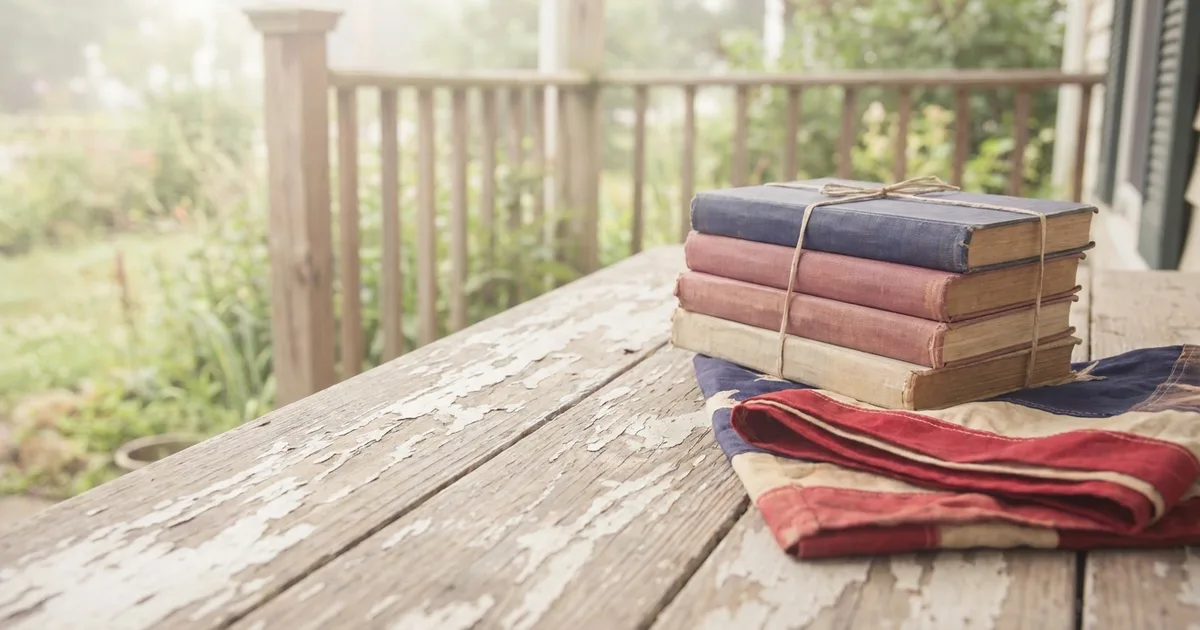
A stack of worn early American books beside folded flag bunting on a porch table.
Around every Fourth of July, the auction houses roll out their Americana, and the results make headlines. Then a few million people look at the yellowed Declaration hanging in the hallway and wonder.
So here is the real market, not the folklore: five independence-era printings that actually crossed the auction block in recent years, what each one brought, and why. The prices are real, the sales are documented, and the pattern they form tells you almost everything about how value works in old American books.
The short answer
- Five recent sales, from top: $4.42 million, $3.36 million, $2.4 million, $975,000, and $203,200.
- Every one was a specific, documented early printing, identified down to the printer, the year, and often the previous owners.
- The same title can sell for wildly different money: two copies of the same 1823 Declaration printing sold for $975,000 and $4.42 million. Provenance and condition made the gap.
- The souvenir copy in your hallway is not one of these, and knowing that quickly is worth something too.
1. The Declaration of Independence, 1823 Stone facsimile: $4.42 million
In July 2021, Freeman's in Philadelphia sold a copy of William J. Stone's 1823 engraving of the Declaration for $4.42 million, more than five times the high estimate. Stone spent three years engraving an exact copy of the fading original at the government's request; 201 parchment copies were made. This one came with the provenance that makes auction rooms lose their composure: it had descended through the family of Charles Carroll, a signer of the Declaration.
The lesson: the printing sets the floor, the provenance sets the ceiling.
2. A July 1776 New York printing: $3.36 million
In June 2024, Sotheby's sold a Declaration printed on July 11, 1776, one week after independence, by John Holt of the New York Journal, for $3.36 million. It is a strange and wonderful object: a hybrid between a newspaper and a broadside, one of only five recorded copies, and the only one in private hands.
The lesson: in early American printing, days matter. The closer to July 4, 1776 a printing sits, the rarer and more historic it is.
3. The Exeter broadside, July 1776: $2.4 million
In January 2025, Sotheby's sold one of about ten known copies of the Declaration broadside printed by Robert Luist Fowle in Exeter, New Hampshire in July 1776, for $2.4 million. This copy, known as the Goodspeed-Streeter-Sang copy after its celebrated twentieth-century owners, was one of only three to reach auction in the past century.
The lesson: named provenance is not decoration. A copy whose ownership chain is documented across a century sells with confidence money.
4. The Declaration, 1823 Stone facsimile again: $975,000
Here is the pair that teaches the most. In 2019, Sotheby's sold another of the same 201 Stone facsimiles, the Thomas Emory copy, for $975,000. A genuine, documented copy of the exact same printing as the $4.42 million Carroll copy, at less than a quarter of the price.
The lesson: identical printings are not identical objects. Condition, completeness, and especially whose hands a copy passed through move the price by multiples, not percentages.
5. The Federalist, 1788 first edition: $203,200
In November 2024, Freeman's | Hindman sold a first edition of The Federalist, the 1788 collection of the essays Hamilton, Madison, and Jay wrote to argue the Constitution into existence, for $203,200, more than triple the estimate. This was a thick-paper presentation copy believed to have belonged to a Revolutionary War veteran, one of only about seven such copies to reach auction in fifty years.
The lesson: the founding era's books, not just its documents, carry serious value in the right printing. An ordinary 1788 Federalist is worth a great deal less than a thick-paper presentation copy; the specific issue is everything.
What this means for the copy in your attic
Now the honest part. The Declaration you inherited is almost certainly none of the above. Souvenir reproductions have been printed continuously since the nineteenth century, and the 1976 Bicentennial alone put hundreds of thousands of imitation-parchment copies into American homes. The browned, crinkled "aged" look is part of the product. If your copy came framed, from a gift shop, a bank, or a Bicentennial celebration, it is a keepsake, not a collectible.
But notice what every sale above has in common: the value was settled by identification. Which printer, which year, which issue, which owners. Nobody paid $4.42 million for "an old Declaration." They paid for a documented 1823 Stone facsimile with signer provenance. The same rule runs all the way down the market: a $200 book and a $203,200 book look similar until someone reads the printing correctly. That is the skill worth borrowing, whatever is in your box. Start with How to Tell If a Book Is a First Edition, and grade honestly with Book Condition Grading Explained.
The faster way to find out what you have
FirstFolio is an AI tool that identifies and values old books from photos. You upload pictures of the cover, title page, and copyright page, and it identifies the edition and printing, grades the condition, and returns an estimated market value range in about 60 seconds. It will not find a Dunlap broadside in your attic, almost nothing will, but it will tell you exactly which printing you own and what that printing actually sells for.
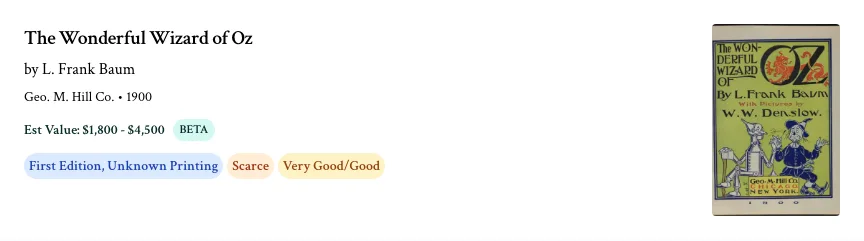
You can check two books free, no card required. Find out what your book is worth.
Frequently asked questions
Is my copy of the Declaration of Independence worth anything? Almost certainly not as a collectible: nearly all copies in homes are souvenir reproductions, many from the 1976 Bicentennial. The valuable ones are documented historic printings, like the 1776 broadsides and the 201 Stone facsimiles of 1823 in the sales above.
How can I tell if my Declaration copy is a real early printing? Provenance and paper first: gift shop, bank giveaway, or Bicentennial souvenir means reproduction, and artificially browned "parchment" is a souvenir trait. A genuine early printing is rare enough that if you truly cannot rule it out, it deserves professional confirmation.
What old American books are actually valuable? Early imprints, first editions of landmark works like The Federalist, small-printing firsthand accounts, and copies with genuine provenance, all graded honestly on condition.
Why did two copies of the same 1823 Declaration printing sell for $975,000 and $4.42 million? Provenance and condition. One descended through a signer's family; the other did not. Identical printings routinely sell for multiples apart on those two factors.
Where are these prices from? Documented auction results: Freeman's (2021), Sotheby's (2019, 2024, 2025), and Freeman's | Hindman (2024), as reported by the auction houses and the rare book trade press.
Related reading: